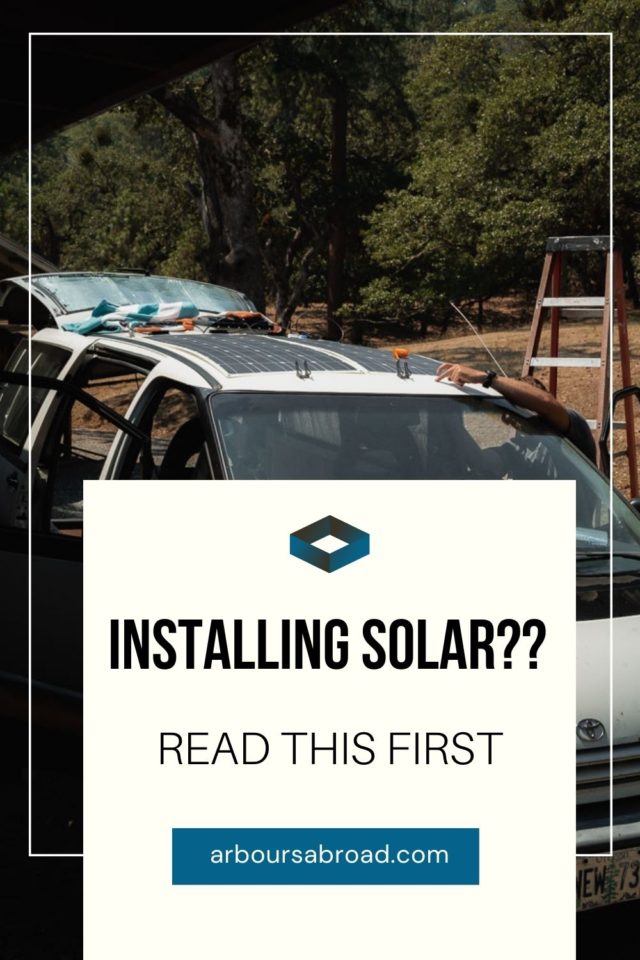

Camper van solar panel mistakes are inevitable. There’s always room for error when converting a camper van. And just as we did, you’ll surely have mistakes here and there. Don’t let it deter you from converting your own campervan though! Mistakes are just room to learn and grow.
With that said, we made or almost made a handful of mistakes when installing our solar panels. And we thought that if we wrote them down and shared them, you can avoid the mistakes we made!
This post contains affiliate links. As an Amazon Associate, we earn from qualifying purchases. If you buy through one of our links, we may earn a small commission at no extra cost to you. Read our full disclosure policy.
10 Camper Van Solar Panel Installation Mistakes
1. Not adding fuses.
Fuses were not on the brain when I (Heather) was organizing and buying all our solar panel mounting and installation materials. Fuses seemed like an optional add-in for the solar panels, as I only saw them in a few of the solar panel diagrams I had looked through. However, this isn’t the case.
Installing fuses into your solar panel system creates an intentional weak point in your entire system. While intentionally adding a weak spot seems bad, it’s actually a really good thing. A fuse (the intentional weak spot) is there to break instead of breaking your more precious and hard-to-replace things like a charge controller or the actual solar panels themselves!
2. Connecting two different-sized camper van solar panels.
When we were doing the painter’s tape on the roof of the van, we legit had it laid out to do two different size camper van solar panels on the roof. I thought if we have room for more, why not just add them? After we had our idea all mapped out, I double-checked to see if you can connect two different size solar panels, and it turns out you can’t.
Connecting two different-sized solar panels results in an uneven charge… which is a no go for solar power. Make sure that your solar panels are the same size and age when combining more than one camper van solar panel.
READ MORE | Choosing the Best Solar Panel for Your Van Build
3. Using the tape the cable mounts come with.
This one is a mistake that we made, which we luckily caught before getting on the road. The zip tie mounts we bought for securing the solar panel cables to the roof sucked. Even when applied to a freshly cleaned surface, they came off overnight.
We used construction adhesive after that little mishap because we didn’t want it to happen again on the road. However, this tape is also a good tape to use, as it’s construction grade!
4. Not considering the weight of sealed lead acid batteries compared to LiFePO4 batteries.
It literally pains me every time I think about this. Lithium Iron Phosphate batteries are SO STINKING LIGHT compared to sealed lead acid or AGM batteries. Lithium Iron batteries are more expensive than the normal AGM batteries, but with the weight difference alone, you’ll be saving in gas. Not to mention the next point.. making it even more of a no-brainer to buy LiFePO4 batteries instead of the AGM ones!
5. Not taking into account the discharge range of lithium iron batteries verse AGM batteries.
As if the point above wasn’t a punch in the gut enough, Lithium batteries can use more of the energy they store. Regular AGM batteries can only be discharged to 50% of their battery storage before ruining the battery. While Lithium batteries can be discharged nearly 100%.
This means an AGM battery with 100 amp hours of power only gives 50 actual usable amp hours.
A Lithium battery with 100 amp hours of power gives nearly 100 actual usable amp hours.
So, you have to have two AGM batteries (about 70 lbs a piece and around $250 each), to get 100 amp hours, or, one LiFePO4 battery (around 29 lbs and $500 each) for the same 100 amp hours of power. That’s a no-brainer to getting the Lithium battery instead of the regular AGM battery.
NEED MORE REASONS | check out this post for more on why LiFePO4 batteries are worth the cost!
6. Drilling holes in your roof without the actual camper van solar panel in hand.
Okay, obviously, you’ll be planning out the general idea of your campervan roof layout without your actual solar panels. What we mean here is not planning the roof layout to a t and drilling holes and whatnot without first laying out your solar panels on the roof.
We had our idea of where the solar panels would lay on our roof, but then when we got them and put them in place, we quickly learned the way the solar panel cables lay actually made them not fit on the roof how we planned. We had to completely move the panels and put them on the front of the van roof instead of along the side to make them actually fit.
Thankfully, we didn’t drill any holes in the roof or make any cuts in the roof before learning our perfect van roof layout really wasn’t so perfect at all.
7. Mounting flexible solar panels without an air gap.
Rigid or hard solar panels naturally have a built-in air gap based on the mounting system they come with. This is not the case with flexible solar panels. The lack of air gap is the single most problematic aspect of flexible campervan solar panels. An air gap provides space for air to flow beneath the solar panels, allowing a cooling process to happen.
Without an air gap under your flexible solar panels, the panels can overheat and get hot spots, ruining the panels.
Check out what we used for an air gap in this post here + video here.
8. Keeping Butyl tape in the heat.
Butyl tape is a super tacky tape. It’s not like your normal tape but is instead like a sticky tack. When left in the heat, Butyl tape becomes super sticky. It’s literally like a caramel bar.
To prevent the tape from getting super sticky, keep the Butyl tape in the fridge or freezer until you’re ready for use. While it’s out, you could keep an ice pack on it to prevent it from getting too sticky.
Butyl tape is a tape that is used to create a water barrier/seal for any holes in the campervan/RV roof. It’s perfect for each bolt and screw hole in your solar panel installation.
9. Not cleaning up the metal shavings from the drilled holes in the camper van roof.
Drilling holes in the van roof produces itty bitty metal shavings. If not collected, these metal shavings will rust and create rust on your precious campervan build. Use a shop vac or large magnet to collect the metal shavings.
Be careful around the windows of the van. We did not collect all the metal shavings, and then we rolled up and down the front windows, and little pieces of metal shavings got caught in the window trim, scaping the windows as they moved up and down.
10. Using batteries of different ages or ones that are just old!
Just like the solar panels, your batteries need to be the same size and age. It’s best to get two identical batteries. And you’ll want new ones, as batteries only last so long.
They won’t hold as good of a charge the older they are, so be sure your batteries are new and the same!
More Of Our Campervan Mistakes
There ya have it.. all the mistakes we made or almost made when installing our camper van solar panels. But hey, even with these mistakes, we have power on the road and we made it through the build out, creating a lovely home on wheels.
Obviously, we made more mistakes along the way. Check out more of our mistakes in the posts below.
More On Van Builds And Vanlife
How to Install a Campervan Roof Fan
Where and How to do Laundry While Living in a Van
Save For Quick Access Next Time
Did you like this post on camper van solar panel mistakes? It truly helps us tremendously when you save and share our posts with others! It’s a great way to show this post was helpful and we should write more like it in the future. Use these pictures to pin this post on Pinterest! Want to support us in a different way? Find out how here.