
If we’re honest here, we usually just drive in a new country without even paying attention to new rules and regulations for driving there. However, when we were talking with friends about driving to Switzerland, we got a bit scared and began researching actually driving in Switzerland.
And if we’re honest again, what we found about driving in Switzerland, actually made us more nervous to drive through the country! Turns out, it’s really not as bad as it seems, but there are definitely some things to know to avoid major fines, accidents, and even getting your car impounded!
This post contains affiliate links. As an Amazon Associate, we earn from qualifying purchases. If you buy through one of our links, we may earn a small commission at no extra cost to you. Read our full disclosure policy.
15 Things To Know About Driving In Switzerland
You Need The Swiss Motorway Vignette
This is basically the your “toll” for driving in Switzerland. And honestly, it’s so insanely cheap for the amount of tunnels and nice roads you drive on (and considering the pass is good for an entire year)!
You only need this pass while driving on the main motorway. If you’re just doing a quick trip in and out of the country, you may be able to pass on purchasing the vignette by taking smaller highways and side roads instead.

Purchasing Your Vignette
The Swiss Vignette costs 40 Swiss Franc (roughly 40 USD). All the main border crossings sell the vignettes. You simply need to pull over when you cross the border and go into the border crossing building to purchase it.
This can take some time as you’ll be waiting in line at the same place everyone does for their VAT refunds. Alternatively, you can purchase the vignette online, though you’ll pay shipping fees upwards of 10 USD to ship it to any country!
We’ve also heard you can purchase vignettes from gas stations around Switzerland too.
READ MORE | Swiss Motorway Vignette
Traveler’s Tip… If you’re driving a caravan or pulling any type of trailer, you’ll need a vignette sticker for that vehicle as well. Keep this in mind when considering towing something behind your vehicle.
Traveler’s Tip… When purchasing the vignette, be sure to ask to pay in Swiss Franc, if you don’t they’ll charge you in your home currency, and add on a nice 3% conversion fee.
Drive On The Right
As with most other European countries, you drive on the right in Switzerland. This may seem like a no brainer to most, but for us coming from the UK, it’s always a good reminder to read!
Lights Are Mandatory At All Times
Yes, all the time. Day and night, no matter where you are driving in Switzerland, you must have your lights on at all times. We’re not sure if this is because of the many tunnels in the country, or the ever-changing weather, but regardless, make sure you switch yours on every time you turn on your car.
Wear Proper Shoes While Driving
While we don’t have experience with this ourselves, we’ve read it is actually illegal to drive in Switzerland with flip flops or barefoot! How CRAZY is that!?!?
It seems hard to write a ticket for this one, however, what we’ve read is that if you get in an accident you can pay a higher fine if not wearing the appropriate shoes while driving!
Know Who Has The Right Of Way
Oh my goodness, this one almost caused an accident for us our second day in Switzerland. Public transportation (think trams, buses, metros) and emergency vehicles have the right of way. Like, no matter what! It’s crazy.
If you’re on the main road and a bus or other public transportation vehicle is approaching via the side road, they have the right of way to just drive right in front of you! It’s absolutely nuts, so stay on your guard!
We legit nearly got in an accident with a bus in Zurich, and actually saw a car get hit by a tram in the city!
Pay Attention To Cars From The Right
Speaking of who has the right of way, cars on the right have the right of way when at a stop or junction unless otherwise stated. Again, this is a tricky one.
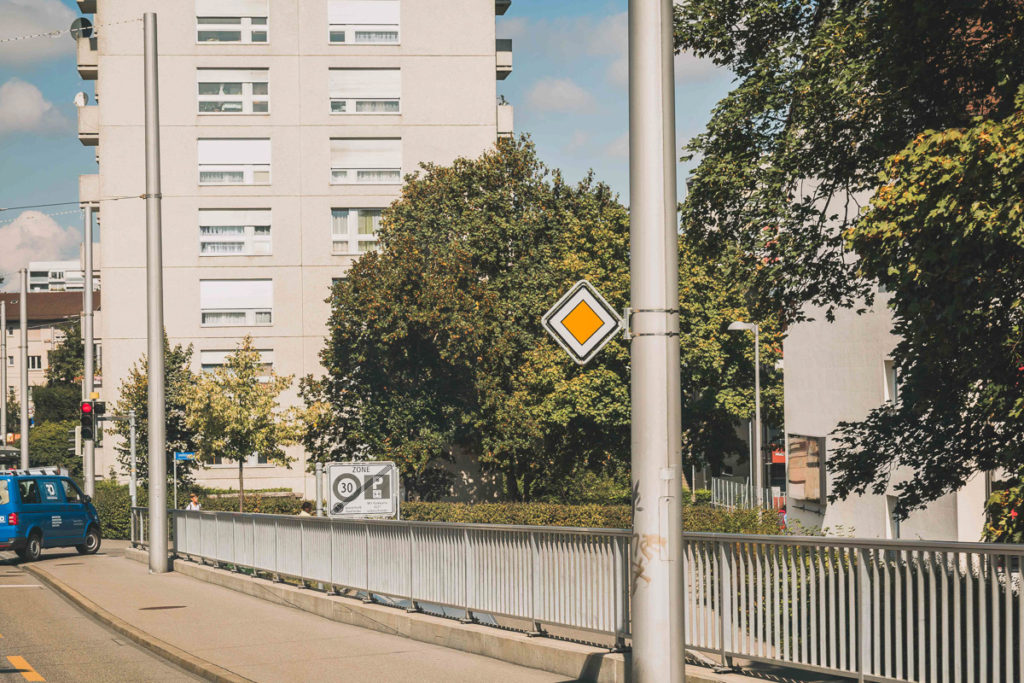
Even if it seems like you’re on the main road driving, unless it’s otherwise stated on the road and/or via a yellow diamond sign (pictured below), the cars on the right have the right to pull out ahead of you. Watch for this especially when driving in rural areas or smaller villages.

Switch Off The Engine
This rule’s an iffy one. While we’ve read that you’re not allowed to run your engine at railway crossings and even traffic lights, we’ve seen quite the opposite. With the exception of the newer vehicles that actually turn themselves off, we’ve yet to see someone turn their vehicles off at a traffic light.
Railway crossings are give and take… we’ve seen signs stating drivers to turn off their engines in some smaller railway crossings near houses, but in most cases, it seems people leave their engines running. Use your best judgment here, and if in doubt, just turn off the car.
Last note on running engines, it’s said that you’re not allowed to warm up the car before driving off as this puts off too much emission in the air. While we were visiting Switzerland it was quite warm, so we didn’t see people warming up their cars, so again, use your best judgment here. But know that it is technically illegal to do so.
Animal Safety In The Car
Driving in the states we always see people driving with their dogs literally in their lap. Every time we see this we think how dangerous that can be! Not a worry about that in Switzerland!
Animals must be in a cage or “grid” while driving so they don’t interfere with the driver.
We never saw animals roaming freely in cars, though, we did see cars with metal bars between the driver’s seat and the back.. we assume this is the necessary “grid” to have while transporting an animal.
Pedestrians Always Have The Right Of Way
Praise the Lord! We love this rule! In Scotland, we would cringe when watching elderly people hobble across the road as fast as they can because they don’t have the right of way, so coming to Switzerland, we were pleasantly surprised to see this was the rule here!
Crosswalks or not, the pedestrian owns the road! Most main roads you won’t see cars stopping for people to cross unless they’re in a crosswalk, however on the smaller roads, no matter where the pedestrian is crossing, they always have the right of way!
Carry A Warning Triangle
Like most other countries in Europe, it’s mandatory to carry a warning triangle in the vehicle at all times. However, in Switzerland, it cannot be kept in the trunk, but has to be accessible by the front of the vehicle.
These warning triangles are to be used if you have to pull over for some kind of emergency and/or break down.
BUY IT HERE | Warning Triangle
You Must Own Or Rent The Car
If simply borrowing a car from a friend to drive into Switzerland, you must pay import taxes on the vehicle dependent on the value of the car. Alternatively, renting a car or owning the car you’re driving, you do not have to worry about this tax, as it only applies when driving a borrowed car without the owner in the vehicle with you.
If you’re driving in Switzerland with a vehicle from another country, be sure to have the registration paperwork with you to show if needed. We didn’t need to prove this at any point, though we’d imagine it could be necessary if we got stopped at the border control or if we got pulled over.
READ MORE | How to Get a FREE Rental Car
Fog and Weather Warnings
When driving in the mountains, be prepared for some severe weather changes. Bring snacks and water with you, just in case it gets too foggy to continue driving safely. The mountains are unpredictable and create their own weather!
People Driving Uphill Have Priority
When on a hill, which happens often in Switzerland, the car going uphill has the right of way. Apparently, some people think this is a no brainer, but it was a new one to us! Makes total sense and seems like common courtesy as starting uphill is more difficult, but know it’s not just courtesy here, it’s the law!
Parking In Switzerland
Blue Parking Passes
While you really can’t save much on parking in Switzerland, the little blue parking passes will save you something! In most places we visited, with the exception of Lauterbrunnen, there are timed blue parking spaces. If you have the blue parking dial (pictured below), you can park in these spaces for, in theory, 1 hour, however in reality up to 1.5 hours.
When parking in the blue outlined spaces, you round up to the next half hour, and then have an hour from that time to return to your vehicle. So let’s say you park at 10:05, you set the blue dial to 10:30, and then have to return to your car by 11:30… meaning you actually get 1 hour 25 minutes of parking.
Purchasing your Blue Parking Dial | Most gas stations sell the blue parking dials. Expect to pay around 6 Franc for one dial. Trust us here, you’ll make back this little investment in the free parking you can get around Switzerland.
Parking for More than 1 Hour | Some of the blue zone parking areas are for more than one hour. Beneath the dial picture on the sign will state a number followed by std. This means you are allotted that many hours to park in that blue zoned area. Keep in mind, as long as you move your car after the set time, even just to the next spot in the row, you can park in that blue zone for longer! (You just have to move your car before your parking time expires!)
Expect To Pay For Parking Everywhere
We’ve yet to come across a town without metered parking. Metered parking is a huge thing in Switzerland. Even in the smallest villages there’s metered parking! It’s quite annoying, to say the least, and is such a turn off from stopping and enjoying a cuppa or bite to eat somewhere. But if you go in prepared, knowing you’ll be paying for parking no matter where you visit, maybe it won’t be as bad!
Traveler’s Tip… Most metered parking in Switzerland is from 7:00-19:00, so if you can snag a spot in the metered zones after 19:00, you can park for free. This doesn’t go for all places, so be sure to check the pay station before assuming it’s free!
Overnight Parking
With the exception of Lauterbrunnen, overnight parking in most areas is free of charge. Like we said above, metered parking typically only runs until 19:00, thus giving you a free parking area from 19:00 – 7:00 the next morning. The blue zone restrictions typically run from 8:00am to 19:00.
So in theory, you can park for free overnight starting at 17:31 and even up to 9:00 in the morning if you park in blue zones (using your free 1 hr. 29 minutes the day before, and the free 1 hour in the morning).
We’ve seen quite a few restrictions with overnight parking of campervans, caravans, and the like around more touristy areas, so be sure to give yourself plenty of time to find a place to park for the night if you’re planning on “wild camping” there!
Extra Resouces For Driving in Switzerland
Parking in Zurich | Learn More Here
This website gives a more detailed explanation of parking in Zurich. Though, honestly the information can be used for parking anywhere in Switzerland. It explains the blue and white zone parking rules as well as bits about using parking garages.
Parking Permits for Zurich | Find them Here
If you choose to not go for free parking or need a longer duration for parking in the city, you can obtain special parking permits. These can be for single day uses or specific parking cards for things such as a handicap or health care personnel. You will also find a list of all the disabled parking throughout the city of Zurich! Such a great resource!
More General Swiss Roadside Information | Learn More Here
This website goes much more in-depth with specific driving rules and regulations for driving in Switzerland. Think things like rules when driving with children, cell phone usage, and more. With easily clickable tabs, this website is great to answer more specific queries about driving in Switzerland.
Checking for Road Closures | Find Them Here
If you’re driving through the Alps, this website is absolutely brilliant for checking driving conditions, road closures, detours and more. It’s a great tool to use when driving through the Swiss Alps.
More On Switzerland Travel
READ MORE | Visiting Lauterbrunnen
Can you escape the tourism of Lauterbrunnen? I think we did our best.. Find out if it’s really worth the visit for you!
READ MORE | Switzerland Grocery Costs
How to save money while traveling in Switzerland. What stores offer the best deals, and what to expect to pay for your groceries!
READ MORE | You’ve Got to Drive this Swiss Alps Pass!
Our favorite drive in Switzerland, and super close to Lauterbrunnen and truly not too far from Zurich! Check this Swiss Alps Pass out!