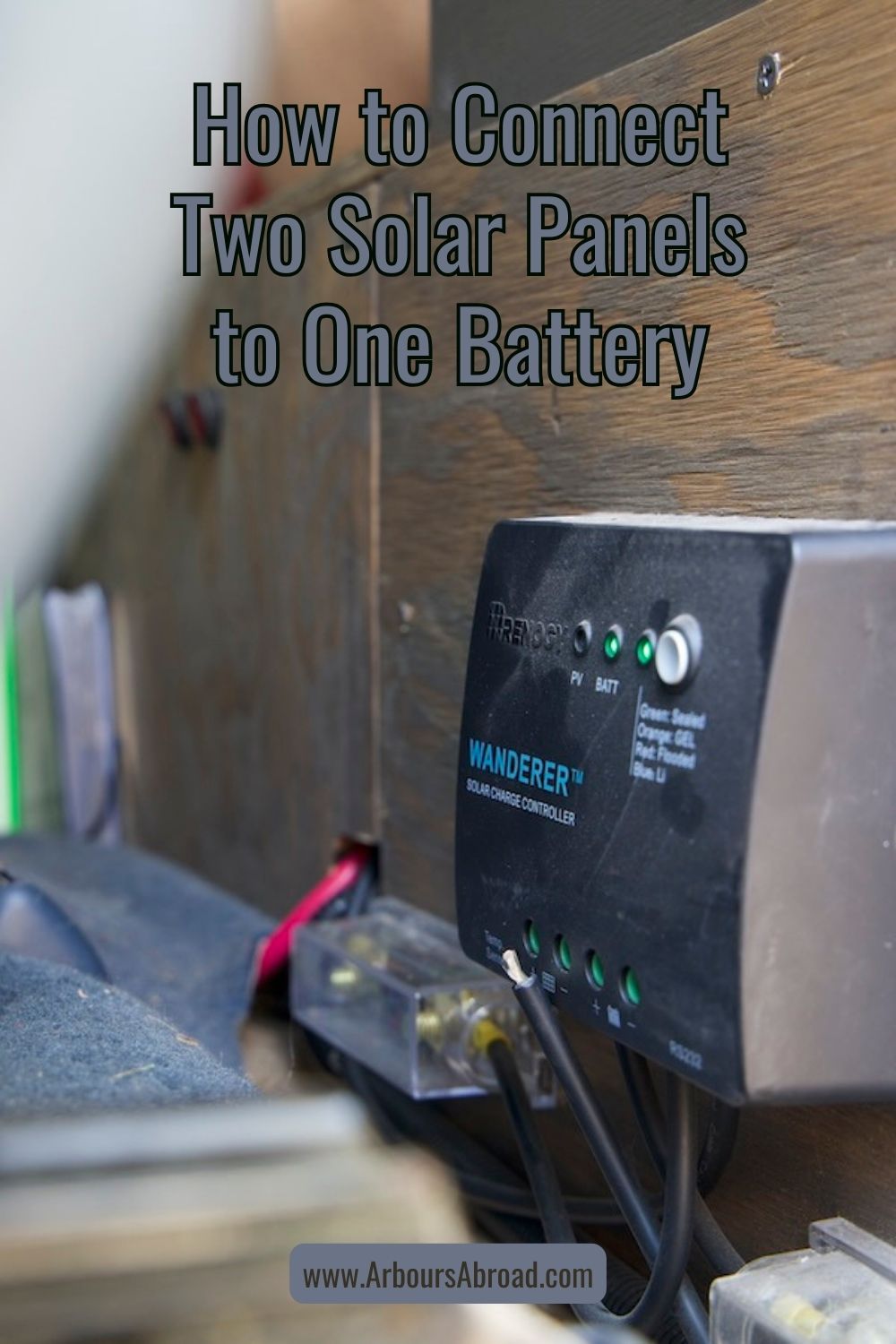

Wondering how to connect two solar panels to one battery? You’re in the right space! First off, congrats on choosing solar! That means you’re getting closer to being completely off-grid and able to live freely!
Adding solar to a campervan is an exciting part of any van build. But there are so many questions that go along with installing solar power. In this post, we’ll be talking specifically about how to connect two solar panels to one battery. With solar companies providing so many easy gadgets and connectors, it’s actually a lot easier than one may think.
Let’s cover some basics, and then dive into a step-by-step connecting guide.

This post contains affiliate links. As an Amazon Associate, we earn from qualifying purchases. If you buy through one of our links, we may earn a small commission at no extra cost to you. Read our full disclosure policy.
Choosing the Best Kind of Solar Panels for Your Van
There used to be not many options for solar panels for van builds. However, that’s not the case anymore. Nowadays, there are so many panel options, it’s hard to know what are the best solar panels for your van build. Since this isn’t the main focus of this post, I’m just going to share three different main options for solar panels for a campervan.
100W Flexible Solar Panels | check current prices here
We used flexible solar panels we used in both of our van builds. In our first van in Scotland, we didn’t have the panel mounted to the roof and instead stored the solar panel behind our seat, taking it out when we needed a charge. This worked out really well, as we really didn’t use too much solar in that van.
In our current van, we have two of these solar panels mounted to the roof. They have been a godsend in keeping our leisure batteries topped up.
100W Monocrystalline Solar Panels | check current prices here
These 100 watt panels are not flexible panels, but are instead a solid panel complete with framed in mounting system. They have multiple layers to them, making them more durable and stronger than the flexible solar panels. These 100 Watt panels are what most people have on their campervan conversions.
The major downside to these panels is the weight. Unlike the flexible solar panels that weight just over 4 lbs., these solid solar panels come in at 14 lbs. each. This is a considerable weight difference when converting a smaller van.
Foldable Solar Panels | current prices here
For those not really 100% sure about setting up an entire van solar system, these foldable solar panels are a great choice. If you aren’t planning on doing van life full time, and are instead just doing a long road trip.. it may be worth it to just grab these foldable solar panels and a Jackery Portable Power Station instead of putting the holes in your van roof and spending all the extra money on a complete solar system set up.
Materials and Tools Needed to Connect Two Solar Panels to One Battery
After scouring the interwebs, reading more blog posts than we can count, and watching more videos than we can remember, we finally bought “all” the things needed for a total solar system set up with two 100W Renogy Flexible Solar Panels. However, we were super frustrated when we laid out everything to visualize the total set up, only to find we were missing multiple important pieces.
Things like zip ties and mounts to prevent the solar panel cables from blowing around in the wind. Cable glands.. the items used for inserting solar panel cables and any other cable into the van roof with a water-tight seal. And even fuses… the big ones to prevent blowing up our solar panels or charge controller.
After seeing how many missing bits we had, even after researching extensively, we created the ultimate material guide to mounting and installing flexible solar panels. In this guide, you’ll find every single thing we used down to the nut and bolt. And don’t worry, if you’re not using flexible solar panels, you’ll still find a huge benefit in this complete solar panel kit.. as the only thing that is different is the actual mounting hardware.
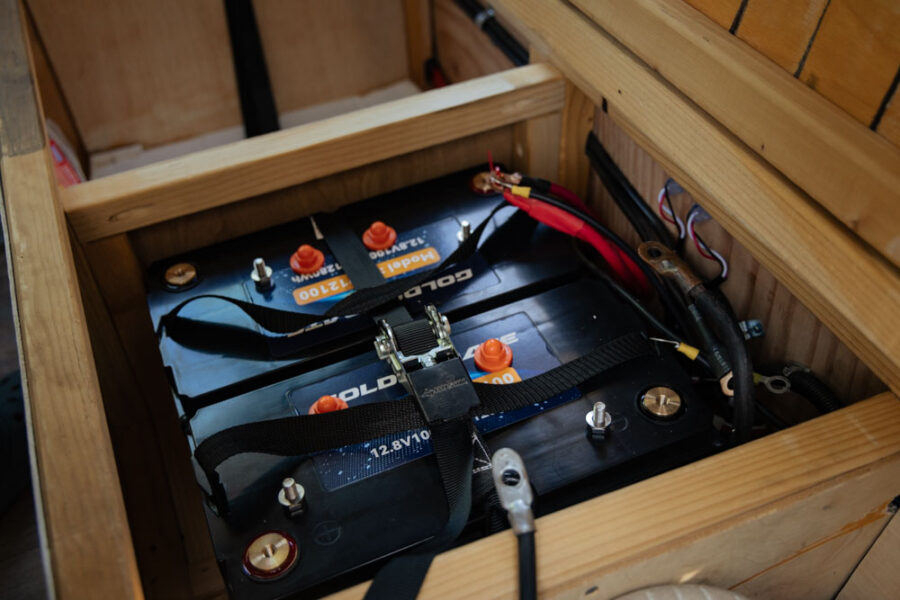
How to Make Two Batteries One Mega Battery
Having two solar panels is great and all, but you also want to be able to have a place to store the energy you collect from those solar panels. If you only have one battery, you’ll be limited at the amount of power you can store.. meaning you’ll be limited in the amount of electricity you can use.
*This is when talking about AGM batteries. You’ll be able to have one single battery that produces the same amount of power as two AGM batteries if your one single battery is a lithium iron battery. More on choosing the best batteries in this post here.
READ MORE | Our NEW 100 Lithium Iron Batteries in Full Review
Generally speaking… More batteries = more power storage. Which equals more power!
Luckily, turning two batteries into one battery is actually quite simple! Just follow the steps below. We’ll also be creating a video of this process for the visual learners out there! The video makes it so much easier to understand the written words in my opinion!
- Place batteries in your campervan. You should have them in an enclosed area, protected from moisture.
- Connect the positive ends of the battery together with 0, 2, or 4 gauge wire.
- Connect the negative ends of the battery together with same gauge wire used for the positive ends.
- Ground the batteries with a 0/2 gauge wire, coming from the negative terminal of one battery.
Things to note about connecting two batteries, creating one mega battery…
- Your batteries should be secured to the van.. you don’t want 70 lb batteries rolling around if an accident occurs.
- The two batteries you are connecting together need to be the same exact battery. Same type, age, and size. This allows proper charge and discharge of the batteries.
- The cables used to connect the positive and negative ends of the battery need to be the exact same length. You’ll see them sold on Amazon in pairs for this exact reason.
- The shorter the cables used to connect the batteries together, the more efficient the batteries are.
- Grounding the battery is done from the negative end (negative terminal) of the battery. You simple place the cable on the battery and find a metal bit of your van frame to then secure the cable to the van by drilling in, or “grounding”, the wire.
- All positive connections to the battery need to go to one battery, while all negative connections to the battery need to go to the other battery.
Do This First.. Or You’ll Ruin Your Solar Panels
Before jumping into connecting two solar panels to one battery, you need to know something super important..
You need to connect your batteries together to make one battery, then connect the new mega battery to your charge controller.
If you don’t have the battery connected to the charge controller first, you risk damaging the charge controller and solar panels and even risk a fire. Connecting the battery to the charge controller essentially allows the power/energy gathered from the solar panels to go somewhere.
Connecting the solar panels to the charge controller before connecting the batteries, basically supplies energy to the charge controller with nowhere for it to go.. que major disaster and destruction!!
Again… first you need to connect your battery to your charge controller. To do so, you’ll be using these tray cables, this 30A ANL fuse + case, this charge controller, a wire stripper, and materials from this copper wire connector kit.
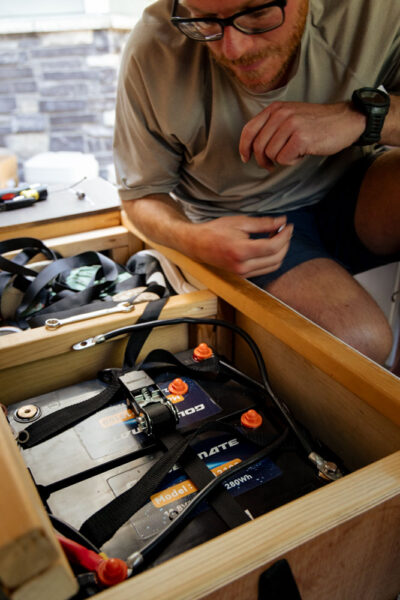
How to Connect Batteries to Charge Controller
- Mount the charge controller in a place where you can feed tray cables into the bottom of the charge controller easily. Note, you’ll also need space on both sides of the charge controller to add large ANL fuses.
- Choose a location to mount 30A ANL fuse case, between the charge controller and the battery.
- Measure the distance of wire needed to connect the positive end of the battery to the fuse, then, cut and prepare ends with copper wire connectors. Set this piece aside as you prepare other cables.
- Measure the distance between the other end of the fuse case and the positive plug (port) for the tray cable on the charge controller. Add the copper wire connectors to only one side of this cable. Strip the end of the opposite side so it can be shoved into the positive charge controller port.
- Measure the distance from the negative terminal of the other battery to the negative terminal (port) of the charge controller. Cut the tray cable to size. Prepare one end of the tray cable with copper wire connectors. Using wire strippers, strip the opposite end of the cable so it can be shoved into the negative charge controller port.
- Screw in the positive tray cable into the positive port on the charge controller. To do so, shove the cable into the positive port (located on the bottom side of the charge controller), and screw in the screw hole on the face of the charge controller.
- Connect this cable to the 30A ANL fuse case.
- Attach the prepared tray cable to the other side of the fuse box, and then to the positive battery terminal of one battery.
- Connect the negative tray cable to the charge controller first (just as you did the positive terminal).
- Finally, connect the negative tray cable to the opposite battery. This should be the battery that is grounded.
Connecting Two Van Solar Panels in Parallel
When connecting your van’s solar panels, you want to be sure to do so in parallel. Connecting the solar panels in parallel allows for you to easily add more solar panels if need be, but more importantly, if one panel is in the shade, it doesn’t affect the entire solar system!
Luckily, these days solar panel companies have been really cranking out the perfect materials for connecting multiple solar panels together. Since we went with two 100-watt Renogy solar panels, we continued with Renogy gear for the entire campervan solar system. Just use the provided links to purchase your solar panel gear and follow the steps below. We’ll also be creating a video of this process for better explanation of each step.
To connect two solar panels together, you’ll need the following materials..
100 Watt 12 Volt Extremely Flexible Monocrystalline Solar Panel by Renogy (two panels)
Renogy 1.5Ft 12AWG Solar Extension Cable with Solar Panel Connectors (lengthens cable from solar panel)
Male/Female Pair Branch Connectors (makes two solar panel cables one)
Renogy 10Ft 10AWG Solar Adaptor Wire Extension Cables with Female and Male Connector (connects solar panels to charge controller)
Cable Glands Adjustable 10 Pcs 3/8″ Nylon Cord Grip NPT (for inserting cables into van roof)
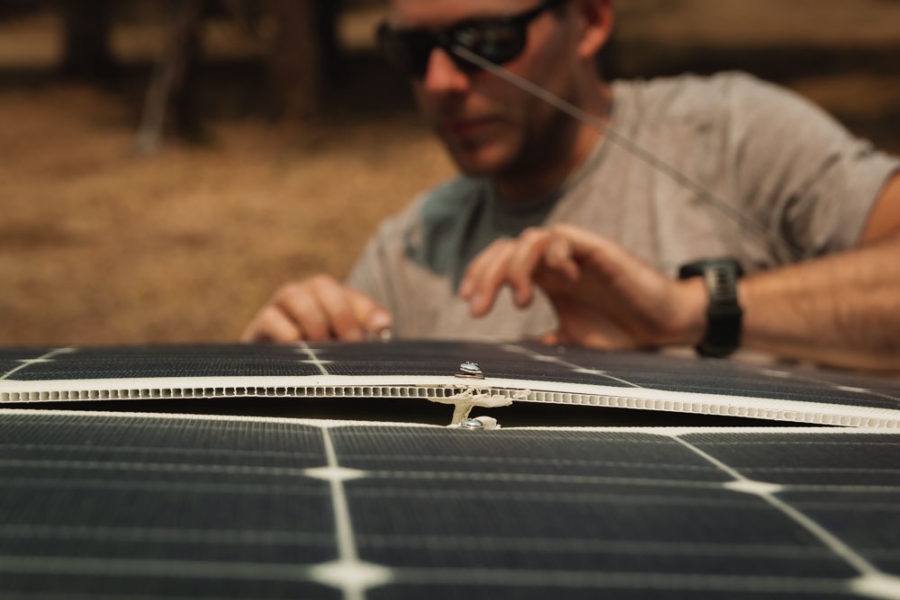
How to Connect Two Solar Panels Together…
- Mount solar panels on van roof. Check out this post for a step by step instruction on how to do this.
- Cover the solar panels with thick blankets or towels. Better to do this part in limited sunlight, as you don’t want the panels to be collecting a charge.
- Use the solar extension cable to lengthen the cable needing to be lengthened.
- This will be dependent on where your entry point is located. The extension cable works for both the positive and negative solar panel cables.
- Using the pair branch connectors, connect the solar panel cables. This step connects two of the same cables, making them become one!
- You truly cannot mess up on this step, as the pair branch connectors and the cables coming from the solar panels are male and female (meaning they have different ends). You will only be able to connect the matching ends to the double side of the pair branch connector. Leaving the single side open for the next connection.
- Plug in, or connect, the extension cables to the pair branch connectors. This can only be done one way, as the male and female ends prevent you from doing so incorrectly.
- Take note here, these cables are now live. You don’t want to be touching the end of both cables at the same time! You can add electrical tape to the ends for added protection if you choose.
- Feed the cables through the cable glands. Be sure to mark which one is positive and which is negative at the ends for inserting into the charge controller.
How to Connect Solar Panels to Charge Controller
If you’ve followed the above sections, you’re at the point of connecting your solar panels to your charge controller. However, it’s worth mentioning again, just in case you skipped to this part.. that before you connect your solar panels to your charge controller, the charge controller needs to be connected to the battery.
Again, you must connect the charge controller to the battery before connecting the solar panels to the charge controller.
Okay, now that that’s out of the way. You’re on your final steps. This will be super easy at this point, as it’s basically the same exact connecting process as connecting the batteries to the charge controller.
How to Connect Solar Panels to Charge Controller…
- Ensure the solar panels are not collecting a charge.. this means they should be covered with thick blankets or, it should be dark out!
- Choose a location to mount 20A ANL fuse case, between the charge controller and the solar panels.
- Measure the distance of wire needed to connect the positive end of solar panel cable to the fuse, cut, and prepare the end with copper wire connectors. Keep in mind, that this needs to be fished behind the wall and in the exact location you want the wire to be. Shorter wire = greater efficiency.
- Connect the positive cable to the fuse case.
- Measure the distance between the other end of the fuse case and the positive solar panel port for the solar panel cable on the charge controller. Add the copper wire connectors to only one side of this cable. Strip the end of the opposite side so it can be shoved into the positive charge controller port.
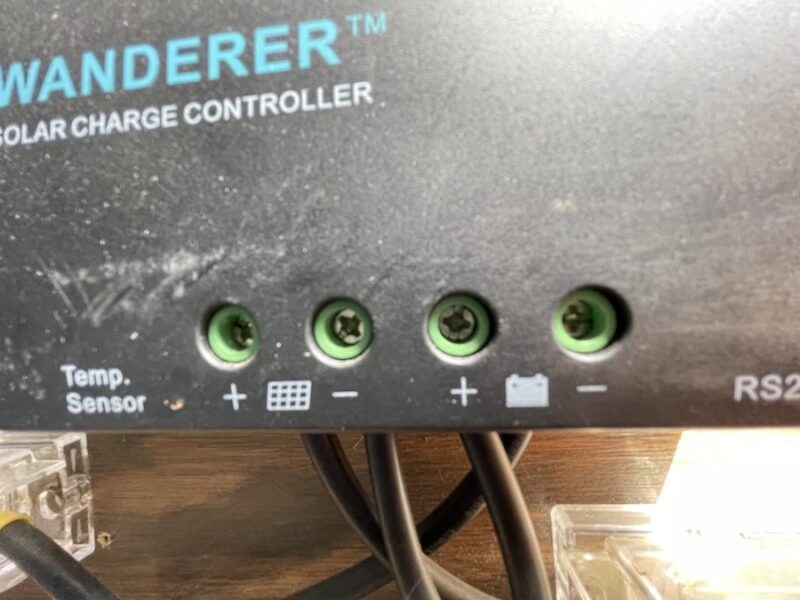
- Screw the positive solar panel cable into the positive solar panel port on the charge controller. To do so, shove the cable into the positive port (located on the bottom side of the charge controller), and screw it into the screw hole on the face of the charge controller. This port should have a solar panel picture above it.
- Time to do the negative wire. This one is without a fuse. Run the negative cable along the van to the charge controller. Cut the cable to size. Use wire strippers to strip the end of the cable so it can be shoved into the negative charge controller port.
- Double-check your battery is connected to the charge controller. This is the last chance to ensure this connection is made before completing the full solar system circuit.
- Connect the negative solar panel cable to the charge controller.
- Remove blankets from the solar panels so you can start collecting power/energy!
- Once the solar panels are in the sun, check your charge controller to ensure the lights are blinking… telling you you’re now collecting solar power!!
You Have Power.. Now What?
Once the solar panels are in the sun, your charge controller should be telling you it’s collecting power and storing it in your batteries. There is a manual that comes with the charge controller explaining what lights should be flashing what green, and what other colors of lights flashing means.
You now have complete solar power. Do not disconnect the batteries from the charge controller without disconnecting the solar panels first. You shouldn’t need to disconnect them for any reason at this point.
If you’re planning to use an inverter, don’t worry, that’s an easy install process.
This is the perfect van-life solar panel system. From here, you can connect a fuse box with fuses to your lights, campervan fridge, outdoor lights, campervan fan, outlets, and more. And of course.. we’ll be creating a step-by-step video and post on all of that as well!!

More on Camper Van Solar Panels
10 Mistakes to Avoid when Installing Your Campervan Solar Panels | trust us, you don’t want to make these
Complete Flexible Solar Panels Kit | every item you need to install solar panels on a campervan
31 Steps to Mounting Flexible Solar Panels | if you’re lost, head here
Minivan Camper Conversion Solar System
More on Van Conversions and Vanlife
The BEST van life Apps | water + parking + dumpstations
Where to Find Free Camping in the United States
Choosing the Best Coffee Makers for Campervans
Can You Actually Insure a DIY Campervan in the United States?
Save for Later and Virtual High Fives
Did you like this post on connecting two solar panels to one battery? It truly helps us tremendously when you save and share our posts with others! It’s a great way to show this post was helpful and we should write more like it in the future. Use these pictures to pin this post on Pinterest! Want to support us in a different way? Find out how here.